Study on Food Use Patents: Particularity of Claims and Infringement Determination
Ran DUAN
Chinese Patent Attorney
[Abstract]
Recent years have witnessed a significant increase in the number of patent applications in the food area. Accordingly, practitioners are increasingly focusing on crafting applications directed to food uses in such a manner that satisfies regulatory requirements on paper while facilitating practical enforcement in their favor.. This article mainly explores strategies for drafting food-use claims and the status quo of infringement determination in China, analyzing the pertinent laws and regulations, patent prosecution, and enforcement.
[Keywords]
Food, new function, patent application, use claim
Since January 1, 1993, food, beverages, and condiments have been recognized as patent-eligible subject matters in China. To date, driven by the rapid development of the food industry and the increasing consumer demand for health foods and functional foods, there has been a significant increase in the number of patent applications for invention in the food area.
Over the past three decades, the examination standards for food-related patent applications in China have followed a general trend toward greater stringency. Between 2007 and 2009, the grant rate of food patent applications filed was approximately 50%1. Since then—particularly in recent years—the grant rate of applications in the food area has declined remarkably and now lags behind the grant rate of applications in other areas. This decline can likely be attributed to an increasingly higher inventiveness bar for patent applications in prosecution coupled with a gradually tightening of examination standards for compliance with the provisions specified in the Food Safety Law of the People’s Republic of China (hereinafter referred to as the “Food Safety Law”) and Article 5 of the Patent Law of the People’s Republic of China (hereinafter referred to as the “Chinese Patent Law”).
Incidentally, beyond applications for general food products and food preparation methods, there is also a year-on-year increase in the number of use patent applications directed to new functions of known substances or compositions, often referred to as “use patent applications for new functions” in the context of functional foods). For example, some literature studies2 documented a significant rise in patent applications relating to intestinal health, mental health, immune functions, and weight management. Concurrently, the market size of functional foods is projected to reach nearly USD 600 billion by 2032, reflecting a growing fervor in this area.
Applications for new functions are subject to not only the general patentability requirements i.e., eligibility, novelty, inventiveness, and practical applicability, under the Chinese Patent Law, but also to a review for compliance under other laws. In this context, the “other laws” primarily refer to the Food Safety Law.
In view of the foregoing, this article focuses on the strategic drafting of claims for patent applications directed to new uses of functional foods—a matter of particular concern to applicants—and hopes to provide practical guidance, based on case studies, for mitigating risks and enhancing application quality.
1. Food-use claim drafting under Article 5 of the Chinese Patent Law
Historically, it was common that a patent application, whether filed by Chinese or foreign applicants, seeks protection for both food and drug uses. Under current, stricter examination standards (particularly the application of Article 5 of the Chinese Patent Law), however, such dual-purpose applications face significant challenges during prosecution.
Pursuant to Paragraph 1 of Article 5 of the Chinese Patent Law, no patent right shall be granted for any invention-creation that is contrary to the laws or social morality or that is detrimental to public interest.
This provision aims to preclude grant of patent rights to any invention-creation that may disrupt public order, lead to crime, or otherwise jeopardize social stability3.
Furthermore, in practice, the examination under Article 5 of the Chinese Patent Law focuses on whether the application complies with the provisions of the Food Safety Law. The Food Safety Law expressly stipulates that “Food” excludes items used for the purpose of treatment (Article 150) and shall not involve disease prevention or treatment functions (Article 71). Therefore, an application relating to the same substance or combination of substances is typically not allowed to claim both the food and drug uses.
1.1 Allowable scope of “new functions”
A use patent application for a new function of a functional food should be typically reviewed to see whether the claimed “new function” violates Article 5 of the Chinese Patent Law.
In principle, a claimed function does not violate Article 5 of the Chinese Patent Law as long as it is not for preventing or treating diseases. In practice, however, a frequent challenge lies in determining whether a claimed “new function” has a prophylactic or therapeutic attribute. Functions concerning anemia, blood pressure, blood fat, blood glucose, and the like fall in a gray area where the non-therapeutic and therapeutic functions overlap.
Consequently, in order to avoid any contravention of Article 5 of the Chinese Patent Law, it is recommended to follow the functions and expressions in the Catalogue of Health Functions Claimable for Health Foods - Non-Nutrient Supplements(2023 Edition) (hereinafter referred to as Catalogue) in drafting the claims. Since the Catalogue sets forth allowable functions of “health food”, by using the expressions of these functions, it becomes apparent that the claimed technical solution concerns only the health food and is thereby distinguished from the use for treatment or prevention of diseases.
It should be noted that the functions entered in the Catalogue are not intended to limit the new functions of the functional foods. Originally the Catalogue was created for the primary purpose of regulating the certification of “health food”. Hence, a patent application can encompass functions other than those specified in the above Catalogue, as long as the claimed function can be clearly distinguished from the functions for disease prevention and treatment.
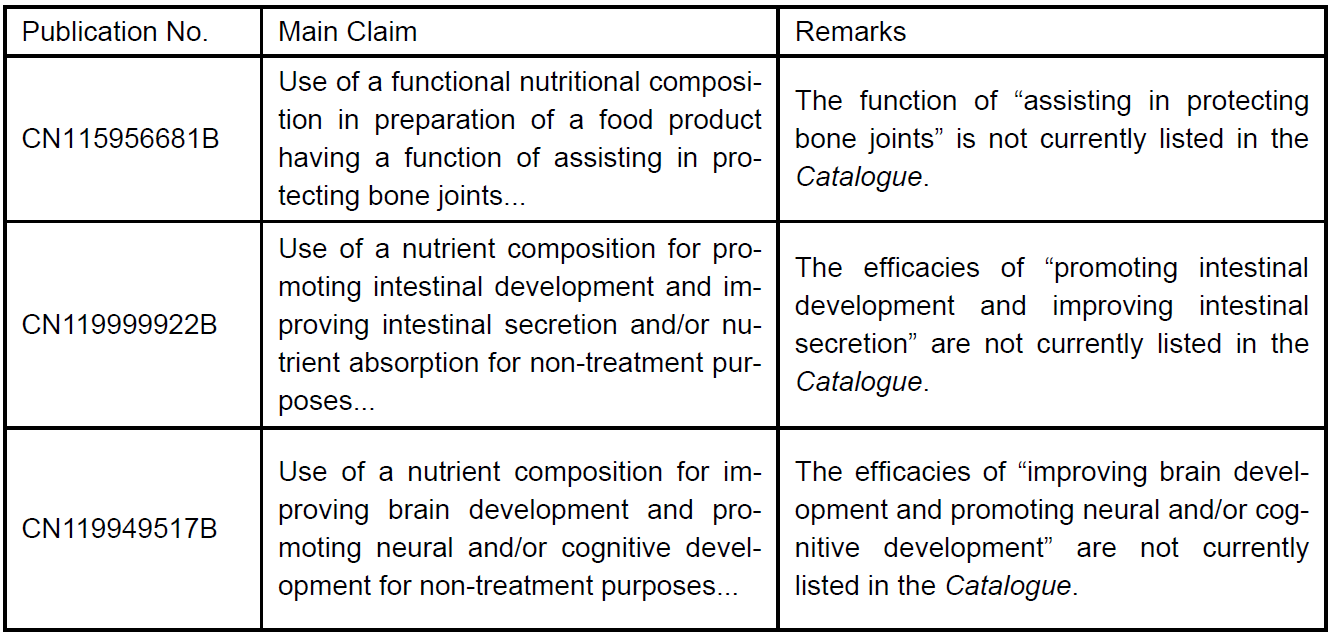
This may be evidenced by the following examples of granted use patents for new functions of foods:
In summary, from the perspective of avoiding any contravention of Article 5 of the Chinese Patent Law, it is advisable to employ the expressions of the Catalogue in a use patent application for new functions of functional foods. Besides, even if the new function involved in a patent application is not listed in the above Catalogue, it can also be defined using language similar to that of the Catalogue to reduce, to some extent, the risk of triggering an objection under Article 5 of the Chinese Patent Law.
1.2 Strategies for defining target subject in claims
Typically, there is no mandatory requirement to define the target subject in the claims of a “use patent application for a new function” of a functional food. Generally applicant may describe the target subject only in the specification as considered necessary.
Nonetheless, there are indeed some exceptions. For example, when there is a potential overlap between the improved function covered by the “new function” and the amelioration of disease symptoms, or when the specification mentions patients with the disease, the claim may be rejected as relating to the prevention and treatment of diseases in the prosecution. In that case, in order to distinguish the claimed solution from the prevention and treatment of diseases, it would be necessary to preclude patients carrying specific diseases in the claims.
Further explanation is provided below with reference to the following Case [1]:
Case [1]
The claims based on which the Decision of Rejection was made read as follows (excerpt):
“1. Use of a composition containing arachidonic acid and/or a compound with arachidonic acid as a constituent fatty acid in preparation of a functional food composition or a health food composition for ameliorating a depressive symptom caused by a decline in physical and mental functions due to aging, wherein …”
The Notification of Reexamination indicated that the “depressive symptom caused by a decline in physical and mental functions due to aging” disclosed in the claims and specification of the concerned application included not only the depressive states in the normal population but also the depressive states in depressed patients, which violated the pertinent provision of the Food Safety Law, that is, it is not allowed to claim disease prevention or treatment functions for food and health food.
In response, the applicant amended the claims (and the specification correspondingly) by defining the depressive symptom as the one in “a non-depressed patient”. This amendment excluded the disease prevention and treatment functions from the use of food and health food, thereby overcoming the alleged defect in the above Notification. Consequently, the Decision of Rejection of the present case was revoked and the present case granted.
The allowed claims read as follows (excerpt):
“1. Use of a composition containing arachidonic acid and/or a compound with arachidonic acid as a constituent fatty acid in preparation of a functional food composition or a health food composition for ameliorating a depressive symptom in a non-depressed patient caused by a decline in physical and mental functions due to aging, wherein...”
Regarding the above case, the author contends that the main trigger of the rejection in the prosecution stemmed from the disclosure of the specification describing depressed patients as the target subject of the composition, which made it difficult to distinguish the solution concerning non-disease prevention and treatment from the solution concerning disease prevention and treatment.
Besides, precluding patients with specific diseases should be interpreted narrowly, that is, it applies only to patients with the specific disease associated with the claimed “new function”. For example, in Case [1], the claimed solution involves ameliorating the depressive symptom, a function associated with the depressed patients. Accordingly, there is no need to exclude patients with diseases unrelated to the “new function”.
Additionally, following the reasoning in Case [1], an alternative approach is to specify “for non-treatment purposes” in the use claim, which can also substantially disassociate the claimed solution from the disease prevention/treatment. This response strategy seems worth trying in practice.
2. Think twice about mechanism features relating to claimed new function in food use claims
Some “use patent applications for new functions” of functional foods may include explanations for the acting mechanism of the new function in the specification. Does introduction of a mechanism-related feature into a use claim contribute to novelty and inventiveness? From the author’s perspective, it depends on the specific circumstances.
In a first scenario, where a component that has been disclosed in the prior art is claimed for a new function, defining the mechanism of action in the use claim can help distinguish the application from the prior art, thereby supporting the inventiveness argument.
In a second scenario, where a known component is claimed for a function that already disclosed in the prior art, introducing the mechanism of action into the use claim will not establish novelty or inventiveness, as the mechanism would be deemed inherent to that known function of the known component.
As a matter of fact, the criteria for inventiveness determination in the first and second scenarios are substantively the same as in the prosecution of applications for new use (the second medical use) in the field of drugs. In this sense, the strategies for patent applications in the field of drugs apply to applications in the food area.
Compared with the above two scenarios, the third scenario described below is more complex and requires case-by-case determination.
In the third scenario, where a different but similar component has been disclosed in the prior art for a use different from but similar to the claimed use, a case-by-case determination is required to assess whether introducing the mechanism of action into the use claim would strengthen the inventiveness argument.
Here is an example - Case [2]:
Case [2]
The claims amended in response to the first office action read as follows (excerpt), with the new limitation underlined:
“1. Use of a functional nutritional composition in preparation of a food product for improving an intestinal health condition, characterized in that the composition comprises phosphatidylserine and a postbiotic …; the improving the intestinal health condition comprises assisting in protecting gastrointestinal mucosa, promoting intestinal peristalsis, and improving intestinal inflammation by increasing a number of intestinal goblet cells; …”
The two prior-art references cited by the examiner described that phosphatidylserine and postbiotics each contributed to improving the intestinal health (without specifically alluding to amelioration of intestinal inflammation). Hence, albeit not identical, both the components and their respective functions in the prior-art references were somewhat similar to those in the concerned application.
The office action asserted that using a combination of phosphatidylserine and a postbiotic for intestinal improvement was obvious. The examiner considered the underlined incorporated mechanism-related feature to be essentially a clinical finding and thus declined to acknowledge it as imparting inventiveness to the use claim. This conclusion likely stems from the examiner’s assessment, based on the cited references, of a high degree of predictability between the claimed component and the intended function.
As shown above, whether defining the mechanism of action contributes to inventiveness may be determined on a case-by-case basis. It is also crucial to note that while defining the mechanism of action in a use claim may contribute to inventiveness in prosecution, incorporating such functional features can complicate the evidence collection for proving infringement under the “all-elements” rule followed in enforcement and infringement determination. Therefore, functional features concerning the mechanism of action must be drafted with caution.
3. Strategic approaches to drafting use claims
For “use patent applications for new functions” of functional foods, the claims are typically drafted in the following two manners: as a general use-type claim (hereinafter referred to as “general use type”), or as a Swiss-type claim (hereinafter referred to as “Swiss type”).
Taking the new-function use of a component A as an example, the claims in the food area are typically drafted in the following two matters:
Swiss type: Use of component A in manufacture of a food product for maintaining blood glucose health; and
general use type: Use of component A for maintaining blood glucose health.
3.1 Scope of protection
Claims drafted in the above two manners do not have substantial disparity in terms of the scope of protection.
The Swiss-type claim was originally devised to circumvent potential rejections under Article 25 of the Chinese Patent Law concerning ineligible subject-matter—specifically, the diagnosis and treatment of diseases—which would render a general use type claim unpatentable. Therefore, when directing to a technical solution in the food area, the Swiss-type claim may not significantly deviate from the general use type claim in terms of the claim scope due to the mere difference in the drafting manner. Claims drafted in these two manners can both be deemed to cover the use of component A in a food product having an efficacy of maintaining blood glucose health.
3.2 Infringement determination
Although the two claim formats do not differ in the scope of protection as described above, they lead to some differences in infringement determination.
Pursuant to Article 114 of the Guidelines for Patent Infringement Determination (2017) by Beijing High People’s Court, in respect of the patent for use invention, the right holder shall prove that the accused infringer makes, uses, sells, offers to sell or imports the accused product for the purpose of the specific use of the patent.
In addition, use claims are method claims. Furthermore, in accordance with Article 11 of the Chinese Patent Law, the scope of protection of the product directly obtained by the preparation method in the method claim extends to the product directly obtained by this patented method.
Based on the above provisions, the author draws the following conclusions:
1) In the case of a Swiss-type claim, an infringing act refers to the manufacture of a food product containing component A for the intended purpose of maintaining blood glucose levels. Moreover, since a Swiss-type claim can be construed as a preparation method, the sales of a product manufactured directly by the patented method also constitute an infringing act under the provisions of the Chinese Patent Law.
Reference may be made to the following examples of judgments concerning infringement to Swiss-type use claims in the field of medicine.
Case [3]
Invention patent infringement dispute of Hunan Warrant Pharmaceutical Co., Ltd. et al. (hereinafter referred to as Warrant) v. Nanjing Sanhome Pharmaceutical Co., Ltd. (hereinafter referred to as Sanhome) ((2020) SPC IP Civil Final No. 1156).
The main claims of the patent in dispute (Patent No.: ZL200510083517.2) of Sanhome are Swiss-type claims, and claim 1 reads as follows: “1. Use of L-ornidazole in the preparation of an anti-parasitic infection medicament.”
The Second-Instance Civil Judgment opined that:
The court finds that: the Supreme People’s Court, in its final judgment (Administrative Judgement (2020) SPC IP Civil Final No. 476), has upheld the validity of Sanhome’s patent. Sanhome subsequently instituted a patent infringement lawsuit before the first-instance court based on the affirmed patent, alleging that Warrant and the other sued parties infringed on Sanhome’s patent by manufacturing, saling, and offering to sell the allegedly infringing product ;
The first-instance court has determined the following main facts of infringement in the Judgment (Civil Judgment (2019) Hu 73 IP Civil First Instance No. 607): the instructions of the accused drug of Warrant describe: “[Drug Name] Levornidazole Tablets. [Ingredients] The active ingredient of this drug is levornidazole. [Indications] The available clinical trial data of levornidazole show that levornidazole is used for treating infectious diseases caused by susceptible anaerobes and urogenital trichomoniasis infections, including: 1. Oral infections: periodontitis, periapical periodontitis, pericoronitis. 2. Trichomonal vaginitis. Therefore, the first-instance court has ruled that (I) Warrant et al. shall immediately stop infringing the patent rights involved in this case; (II) Warrant et al. shall jointly compensate Sanhome for its economic losses...;
The court holds that: the evidence in the case reveals that the allegedly infringing product manufactured, sold and offered to sell by Warrant and the other sued parties clearly indicates its use for treatment of anaerobe and protozoa infections, so it was proper for the first-instance court to order the two companies to cease the infringement upon the patent rights involved in the case.
2) In the case of a general use type claim, an infringing act still covers the act of manufacturing a food product containing component A for the purpose of maintaining blood glucose. However, the claim drafted in this manner is directed to a general use and would be unable to cover the infringing act of selling the product.
Under China’s IP practice, the scope of protection afforded by general use-type and Swiss-type claims directed to the use for new functions of functional foods do not, in the author’s analysis, differ significantly. From a prosecution perspective, the Swiss-type claim can mitigate the risk of triggering the subject-matter eligibility rejection in certain cases. However, for a PCT application filed by a Chinese enterprise in a foreign country, the claims should be drafted to align with local practice to avoid costly subsequent amendments.
The foregoing has explored the prosecution challenges for food use claims and outlined the strategies for crafting such claims based on enforcement considerations. In the author’s view, while the grant of a patent for new functions of functional foods hinges primarily on experimental data substantiating the claimed effects, a strategically structured set of claims—through its careful layout and wording—is also critical. A well-crafted set of claims can secure a reasonable scope of protection, maximize the applicant’s rights and interests and facilitate future enforcement.
——————————————————————————————————————————————
1Xiaona LIU, Current Status of Patent Application Documents and Writing Strategies in the Food area in China,
Meat Research [J], 2018, Vol. 28, No. 03 2Xintian YIN, Introduction to the Patent Law of China [M]. Beijing: Intellectual Property Publishing House, 2011 3The global patent landscape of functional food innovation, Maima Matin et al., Nature Biotechnology [J], volume 42,
pages 1493–1497 (2024)